


In brief. In Italy, an approved helmet is mandatory for both the driver and passenger and must be fastened (art. 171 of the Highway Code). The law requires an approved helmet, not a specific series: an ECE 22.05 helmet in good condition is still an approved helmet, while ECE 22.06 is the current standard, with stricter tests. If you're traveling in Spain, from October 1, 2026, Royal Decree 518/2026 requires motorcycles to have a UNECE R22-approved helmet, not just a "certified" one.
Below, you'll find what the law actually says, how to read the label, what penalties you could face, and what to check before setting off.
An approved helmet is mandatory and must be fastened
Article 171 of the Highway Code is brief and leaves no room for doubt about the principle: anyone riding a moped or motorcycle must wear an approved protective helmet and keep it properly fastened while the vehicle is moving.
What the law says
The requirement applies to both the driver and the passenger. If the passenger isn't wearing a helmet, the driver is also liable. Exemptions apply only to three- or four-wheeled vehicles with enclosed bodywork, and to mopeds and motorcycles equipped with a safety cell, restraint systems, and the devices required by the regulations.
An unfastened helmet is treated like a helmet not worn: fastening the strap only halfway protects neither your head nor your wallet.

The penalties go beyond a fine: the vehicle can be seized
The biggest burden isn't the fine amount but the administrative vehicle seizure, which affects the vehicle's owner even when someone else is driving.
| Violation | Penalty | Source |
|---|---|---|
| Helmet not worn or not fastened | From 83 to 332 euros; InSella also reports 5 points on your license | Art. 171 para. 2 |
| Administrative vehicle seizure | 60 days; 90 days if the violation is repeated within two years using the same vehicle | Art. 171 para. 3 |
| Passenger without a helmet | The driver is also liable | Art. 171 para. 2 |
| Manufacture, import or sale of non-approved helmets | From 866 to 3,464 euros | Art. 171 para. 4 |
| Previously used non-approved helmets | Seizure and confiscation | Art. 171 para. 5 |
ECE 22.05 is not illegal, but 22.06 is today's standard
Italian law requires an approved helmet and does not specify a series of UNECE Regulation No. 22. This is the point that causes the most confusion on forums and in shops.
According to Motorcycle News, production of new helmets with 22.05 certification ended in July 2023, and manufacturers were given until January 4, 2024, to sell off their stock. So anyone who bought a 22.05 helmet before then does not have an "illegal" helmet: they have an approved helmet from an earlier series, which ages like any helmet.
- the label is legible and shows a number beginning with 05;
- the shell, strap and fastening are intact;
- has not been subjected to impacts and is about five years old or less;
- has not been modified with parts not specified by the manufacturer.
- the additional tests in 22.06 (rotational impacts, low and high speed);
- the abrasion test required by the new standard;
- passing the assessment of accessories approved with the helmet.
| Appearance | ECE 22.05 | ECE 22.06 |
|---|---|---|
| Status | Previous series; new production ended in July 2023 | Current standard |
| Impact tests | Linear impacts | Linear impacts plus rotational component, low- and high-speed tests |
| Abrasion | Not included as a dedicated test | Assessed |
| Visors | Series 05 requirements | Stricter impact resistance requirements |
| Validity in Italy | Approved helmet, valid if in good condition | Approved, valid helmet |
The test details are those indicated by the sources consulted (inSella, Motorcycle News). For the threshold values, the text of UNECE Regulation No. 22 is authoritative. The validity of 22.05 in Italy is an interpretation of Art. 171, which does not specify a series.
The label says it all: E in a circle, series and final letter
A homologated helmet has a sewn-in label, usually on the strap. It takes just a minute to read it in front of your mirror at home.
- Look for the E in a circle. The number beside it is the country that granted homologation: E3 Italy, E1 Germany, E9 Spain.
- Read the homologation number. If it starts with 05, it is a 22.05; if it starts with 06, it is a 22.06.
- Check the final letter. J is an open-face helmet, P is a helmet with chin protection, NP means the chin bar is not protective, and P/J is a helmet homologated in both configurations, usually a modular helmet.
- If the label is missing or illegible, consider the helmet unverifiable: that is a problem during a roadside check, and even more so in the event of an accident.
Traveling to Spain? From 1 October 2026, R22 homologation is what counts
For anyone crossing the Pyrenees on a loaded adventure bike, this is a real change: Spanish sources report Royal Decree 518/2026, which amends Article 118.1.a of the General Traffic Regulations.
The new text requires a protective helmet homologated under UNECE Regulation R22, correctly fastened, on all types of roads. The option of a helmet that is merely certified is removed. There is a one-year transition period for mopeds, until 1 October 2027; the extension does not apply to motorcycles.
The decree does not specify the amendment series, so a 22.05 helmet in good condition does not appear to be excluded. For Italian motorcyclists, little changes if the helmet has its E-mark: the homologation is the same. It matters for anyone traveling with a helmet that does not have UNECE homologation, perhaps bought online without checking the label.
Accessories on a helmet: homologation and common sense
Approval applies to the helmet as it leaves the factory. Anything you add afterward (intercom, visor, films, headphones, mounts) is a variable that the helmet manufacturer must account for.
When describing the new features of 22.06, InSella noted that electronic accessories should be approved together with the helmet and for each model, and that an installation not provided for by the manufacturer may invalidate the approval. For this reason, the practical rule is the same one used by manufacturers: read the helmet manual, use accessories compatible with that model, and do not glue or drill the shell.

The Endurrad catalog includes the section for helmet accessories for adventure, enduro, and touring motorcycles, as well as the section for motorcycle intercoms and Bluetooth headsets. At the time this guide was published, the HL08 visor, R1M intercom, and R1X headset were sold out: you can find them in the collections when they become available again. To compare communication options, read Motorcycle intercom or headsets: what’s the difference?.


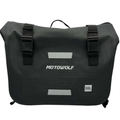
- Material
- 100% nylon
- Color
- Black
- Folded
- 18 × 16 × 7 cm
- Open
- 48 × 31 × 22 cm
- Price
- 18,00 €
Five helmet checks before a long trip
An approved helmet that is old, has been impacted, or is misshapen offers less protection than the label says. Before a long ride, take ten minutes.
- Approval label. Legible and complete, with series 05 or 06.
- Strap and closure. No fraying, buckle that does not slip, adjusted length.
- Shell. No cracks, no unreported impacts. InSella recommends replacing the helmet after a severe impact, even if it does not appear damaged.
- Visor. No deep scratches that impair vision at night or in backlighting.
- Age. InSella generally recommends replacing a helmet after about five years: this is a prudent practice, not a legal requirement.
When you get off your motorcycle, take your helmet with you rather than leaving it hanging on the handlebar, where a gust of wind could knock it off. A foldable helmet bag measures 18 × 16 × 7 cm when folded and fits into a corner of your bag. If you're heading to the Alps in the fall and want to get the rest ready too, read riding a motorcycle in the dark after the clocks change.
Frequently asked questions about approved motorcycle helmets
Is a motorcycle helmet legally required in Italy?
What are the penalties for riding without a helmet or with an unfastened helmet?
Is an ECE 22.05 helmet still legal in Italy?
What's the difference between ECE 22.05 and ECE 22.06?
How can I tell if my helmet is ECE 22.06 approved?
Can you sell a helmet that is not approved?
Do you need an approved helmet in Spain from 1 October 2026?
Is an Italian ECE-approved helmet also valid in Spain?
What is changing in Spain for mopeds?
How often should you replace a helmet?
Can I fit an intercom, a special visor or a film to my helmet?
Are jet helmets banned in Italy?
What should I check on my helmet before a long trip?
Read also
Set off with the right helmet and everything else in order
Try on your helmet in a shop, with your head. For everything else you need on a maxi-enduro or adventure trip, Endurrad offers accessories for communication, protection, luggage, and lighting. And if you want the guide in your pocket, download the Endurrad app for iPhone.