In brief. A centre stand and an enlarged sidestand are not two products that solve the same problem. The enlarged sidestand (in practice, a plate that widens the foot of the standard sidestand) helps when the motorcycle sinks into soft ground, gravel or hot asphalt: it costs €22-45, can be fitted to the original foot in a few minutes and does not affect the motorcycle's geometry. The centre stand helps when you need to load luggage, lubricate the chain or park the motorcycle upright for a long time: on some adventure motorcycles it is an official manufacturer accessory, while on others it is available only from specialist aftermarket suppliers and is a more demanding and expensive installation.
What neither option solves: if you have raised the suspension setup with different suspension components or tyres, the problem is the sidestand's support angle, not its surface area. Here, the plate is not enough: you need to check the motorcycle's compatibility as it is today, not as it left the factory.
The stand is the point where the motorcycle relies on a single support
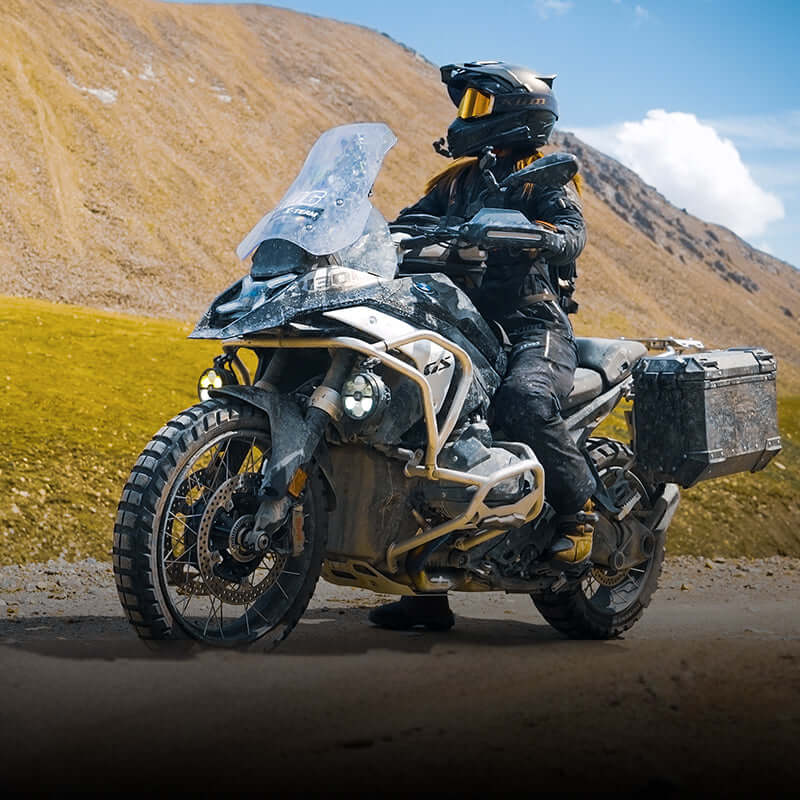
You park a loaded GS during a long transfer, find a gravel lot or an uneven roadside, and the question comes immediately: centre stand or enlarged sidestand? This is not a minor accessory detail, because at that moment the entire weight of the motorcycle, luggage and often a full tank of fuel is transferred to a surface measuring just a few square centimetres.
The right choice depends less on personal preference and more on how you use the motorcycle. Riders who mainly ride on asphalt and tour fully loaded can often solve the problem with a centre stand, if available. Those who frequently ride on dirt roads, make quick stops and want less weight and less bulk underneath the motorcycle usually fare better with a more stable sidestand. Between the two is a grey area shaped by seat height, suspension travel, gradients, luggage weight and routine maintenance while travelling.
An enlarged sidestand solves the terrain problem, not the suspension setup
When people talk about an "enlarged sidestand" in the accessories market, they almost always mean a footplate that attaches over the original sidestand foot without removing it or changing its length. This is the product category that LOBOO calls a sidestand plate and that Endurrad offers for most adventure and maxi-enduro motorcycles on the market.

The principle is simple: by widening the contact point, the motorcycle's weight is distributed over a much larger area. On gravel, sand, grass, hard-packed dirt, or scorching summer asphalt, this substantially reduces the risk of the foot sinking and the motorcycle leaning past its balance point while stationary and unattended. This is the most common problem for those riding mixed off-road terrain or often stopping away from paved roads: the gravel shifts beneath the foot, the ground gives by a few millimeters, and the motorcycle, especially when loaded, loses the angle at which the stand was set up.
On most models, installation requires only an Allen key or a screwdriver and a few minutes: the plate screws onto the existing foot; it does not replace it. It is reversible and requires no modifications to the original stand or the motorcycle.
| Motorcycle | LOBOO code | Price | Availability (23/09/2026) |
|---|---|---|---|
| BMW R 1300 GS | CJC131 | 45,00 € | In stock |
| BMW R 1200 GS LC / R 1250 GS and Adventure | CJC072 / CJC081 / CJC088 | 40,00-40,50 € | In stock (variant for standard or low seat) |
| BMW F 850 GS, F 850 GS Adv, F 900 GS Adv | CJC033 | 40,00 € | In stock |
| BMW F 900 GS (from 2024) | CJC025 | 45,00 € | In stock |
| BMW F 750 GS, F 800 GS, F 900 GS Comfort | CJC031 | 40,00 € | In stock |
| BMW S 1000 XR (from 2021) | CJC062 | 36,00 € | In stock |
| BMW G 310 GS | CJC01 | 22,00 € | In stock |
| KTM 690/790/890/1050/1190/1290 Adventure, Husqvarna Norden 901 | CJC221 | 36,00 € | In stock |
| KTM 1290 Super Adventure S (from 2022) | CJC251 | 36,00 € | In stock |
| Honda Africa Twin, Transalp, Triumph Tiger 900/1200, Suzuki V-Strom 800DE and others | various | 36,00-45,00 € | Check stock availability in side stand plate |
For the models mentioned in the last line, stock availability changes frequently: at the time of this update, several codes (Africa Twin, Transalp, Tiger 900 and 1200, V-Strom 800DE, CFMOTO 700/800MT) show zero units available, so the correct link is the complete collection rather than the individual product page, where you can check the latest availability and receive a restock notification.
The center stand is worthwhile when the motorcycle is stationary for a long time or loaded
The center stand comes into play in situations different from those involving the side stand: loading panniers without letting the motorcycle lean to one side, lubricating the chain, checking the rear-wheel pressure, or leaving the motorcycle upright for days while camping or on a ferry. On heavy models such as the R 1250 GS, R 1300 GS, or Tiger 1200, having the motorcycle properly supported and upright makes these everyday tasks easier to manage.

The availability of a center stand, however, is not consistent. Some manufacturers offer it as an official catalog accessory: Honda, for example, offers one for the Africa Twin and Africa Twin Adventure Sports in its accessory catalog (part number 08M70-MLN-EQ0 for the latest versions). On other motorcycles, such as the Ténéré 700, a road-approved center stand does not appear in the manufacturer's official catalog and is available only through specialists in the touring motorcycle aftermarket (SW-Motech, Hepco & Becker, Touratech, and similar brands), with more complex installation because the center stand affects the subframe and swingarm mounting points.
Enlarged side stand or center stand: the direct comparison
| Appearance | Enlarged side stand (plate) | Center stand |
|---|---|---|
| What it solves | Sinking into soft ground, gravel, hot asphalt | Stability when stationary, luggage load, maintenance |
| What it does not solve | Lean angle after raising the suspension | Quick support during brief stops on the move |
| Installation | Bolt-on installation on the original foot, taking just a few minutes | Work on the subframe/swingarm, plus more time and equipment |
| Indicative price | €22-45 per model | From around one hundred euros to over €200, depending on the model |
| Added weight | From a few grams to around 150 g | From 1.5 to over 3 kg depending on the motorcycle |
| Availability | Wide range of LOBOO products for adventure and maxi enduro bikes | Only on certain models as an official accessory; otherwise, a specialized aftermarket option |
| Ideal for | Mixed gravel roads, frequent and brief stops, light travel | Fully loaded touring, long stops, do-it-yourself maintenance |
The real difference is not just mechanical; it is operational. The side stand, with or without a plate, helps you dozens of times a day, for a few seconds each time. The center stand helps you less often, but in situations where the difference is really noticeable: loading luggage, carrying out maintenance independently, or parking for several days.
LOBOO kickstand plates for BMW GS
- R 1300 GS kickstand plate — CNC aluminum, for mechanical or adaptive suspension
- R 1200 GS LC and R 1250 GS kickstand plate — standard or low seat
- F 750 / F 800 / F 900 GS kickstand plate — for the original foot
- F 850 GS and Adventure kickstand plate — CNC aluminum and stainless steel, 150 g
What really changes when you raise the motorcycle's setup
The most delicate case is different from those seen so far: you have modified the setup compared with the original configuration, for example with raised suspension, different settings, or knobby tires with a slightly larger diameter.
On a Ténéré 700, a KTM 890 Adventure, or an Africa Twin prepared for mixed use, just a few extra millimeters of ground clearance are enough to change the angle at which the side stand touches the ground. The result may be a motorcycle that remains too upright when parked, making it less stable on firm ground or a slight slope, or one that leans too far, making it harder to raise when fully loaded.
With the center stand, the problem is most noticeable when you have to lift the motorcycle: if the height has increased, the leverage gets worse, the effort increases, and the rear wheel may remain too close to the ground to work properly on the chain, tires, or for basic maintenance.
How to choose in practice, in three questions

Start with three simple questions. First: have you changed the motorcycle's height from its original configuration? If so, the issue is one of geometry and must be addressed first, regardless of which stand you use. Second: how much maintenance do you perform yourself while traveling, and how often do you load heavy luggage while stationary? Third: is your main use off-road with quick stops, or asphalt with long transfers and a full load?
- You tour on asphalt with full luggage and long transfers: if your motorcycle has an available center stand, it often pays off in everyday practicality.
- You ride mixed off-road terrain or take short trips and want an essential setup: a side-stand plate is the most straightforward and least invasive solution.
- You often stop on gravel, sand, or scorching asphalt: the stand plate prevents sinking without adding significant weight.
- You have raised the motorcycle's suspension: first check the support angle of the original stand, then consider accessories.
- You travel with a passenger, side panniers, and a top case: a stable base when stationary, whether a center stand or reinforced side stand, reduces unnecessary movement while loading.
The most common mistakes when choosing a stand
The first mistake is evaluating the stand with the motorcycle unloaded, on a level floor, in the garage: under ideal conditions everything seems fine, then the first uphill parking spot on compacted dirt reveals the real problem. The second is confusing a stand plate with a solution for modified suspension geometry: it widens the support, but does not change the angle. The third is fitting an aftermarket center stand that is not model-specific, ignoring that it affects structural parts of the motorcycle (subframe, swingarm), where compatibility by year and version matters more than in other accessory categories.
On Endurrad, this type of choice matters precisely because it is not about adding another part, but about how the motorcycle behaves when it really matters: when you leave it stationary, loaded, on ground you did not choose.
Frequently asked questions about the enlarged center and side stands
Which is better for an adventure motorcycle: a center stand or an enlarged side stand?
It depends on how you use it. The enlarged side stand (plate) is the simplest and most affordable choice for those who ride mixed gravel roads and make short stops. A center stand is worthwhile for those who often load the bike while stationary or carry out maintenance independently during long trips, when one is available for the model.
What exactly does a stand plate do?
It screws onto the foot of the original side stand and widens its support surface, distributing the bike's weight over a larger area and reducing the risk of sinking into soft or yielding ground.
Does a stand plate change the bike's lean angle when parked?
No. It only adds contact surface at the same point where the stand already touches the ground: the length, and therefore the lean angle, remain as set at the factory.
When do you really need a center stand on an adventure motorcycle?
When touring fully loaded on asphalt, when you need to load luggage without letting the bike lean, or when carrying out routine maintenance (chain, tire pressure) on a trip without a workshop available.
Is a center stand available for all adventure motorcycles?
No. Some manufacturers, such as Honda for the Africa Twin, offer it as an official catalog accessory. On other models, such as the Ténéré 700, a road-approved center stand is available only through specialists in the touring motorcycle aftermarket.
What happens to the side stand if I raise the bike with different suspension or tires?
The angle at which the stand touches the ground changes. The bike may remain too upright (less stable on a slope) or lean too far (more difficult to lift upright when fully loaded). This is a geometry problem, not a support-surface problem.
Does a stand plate solve the problem caused by a raised setup?
No. It solves sinking on soft ground, not the lean angle after a change in ride height. If you have significantly modified the setup, first check the stand's safety angle with whoever carried out the modification.
Is an enlarged side stand legal to install in Italy?
A support plate that only widens the foot of the original stand, without changing its length or geometry, does not alter the bike's approved characteristics. Extensions that lengthen or shorten the stand are a different matter: the most cautious choice is to stick to products designed for the specific model and, in case of doubt, ask for confirmation from whoever carried out any suspension modifications.
How much does a LOBOO stand plate cost and weigh?
Prices range from €22 to €45 depending on the model, with a weight that in most cases ranges from a few grams to approximately 150 g, according to the technical specifications for the specific item code.
Can the stand plate be easily removed and reinstalled?
Yes. On most models, it is secured with screws to the original foot without removing the stand, and it is a reversible operation that takes just a few minutes and common tools.
Is the stand plate suitable for hot or wet asphalt?
Yes, it's one of the most common uses: by widening the support area, it reduces the risk of the stand's foot sinking into asphalt softened by summer heat or slipping on a wet, smooth surface.
What are the real disadvantages of a center stand?
It adds weight and mechanical complexity, can reduce ground clearance during more demanding off-road riding, and not everyone finds it convenient to operate on tall, loaded motorcycles, even when it is installed correctly.
How do I know if my motorcycle needs an enlarged stand?
If you often stop on gravel, sand, grass, or hard-packed dirt and have noticed the stand sinking even slightly, the plate solves that specific problem. However, if you have changed the ride height or tires, the first thing to check is the original stand's support angle, not to purchase an accessory.
Is the motorcycle stand plate compatible with the gear/ignition cut-off sensor on the side stand?
Yes, in most cases: the plate attaches to the ground-contact foot, while the safety sensor that disables the drivetrain when the stand is lowered is integrated into the stand's pivot and is not affected by installation.
Don't know which stand your motorcycle needs?
Tell us the make, model, and year: we'll let you know whether a LOBOO motorcycle stand plate is available for your model, its availability, and whether your situation (terrain, load, modified setup) really requires a center stand rather than an enlarged side stand.
Learn more: BMW R 1300 GS accessories · BMW R 1300 GS Adventure accessories · motorcycle handlebar risers