

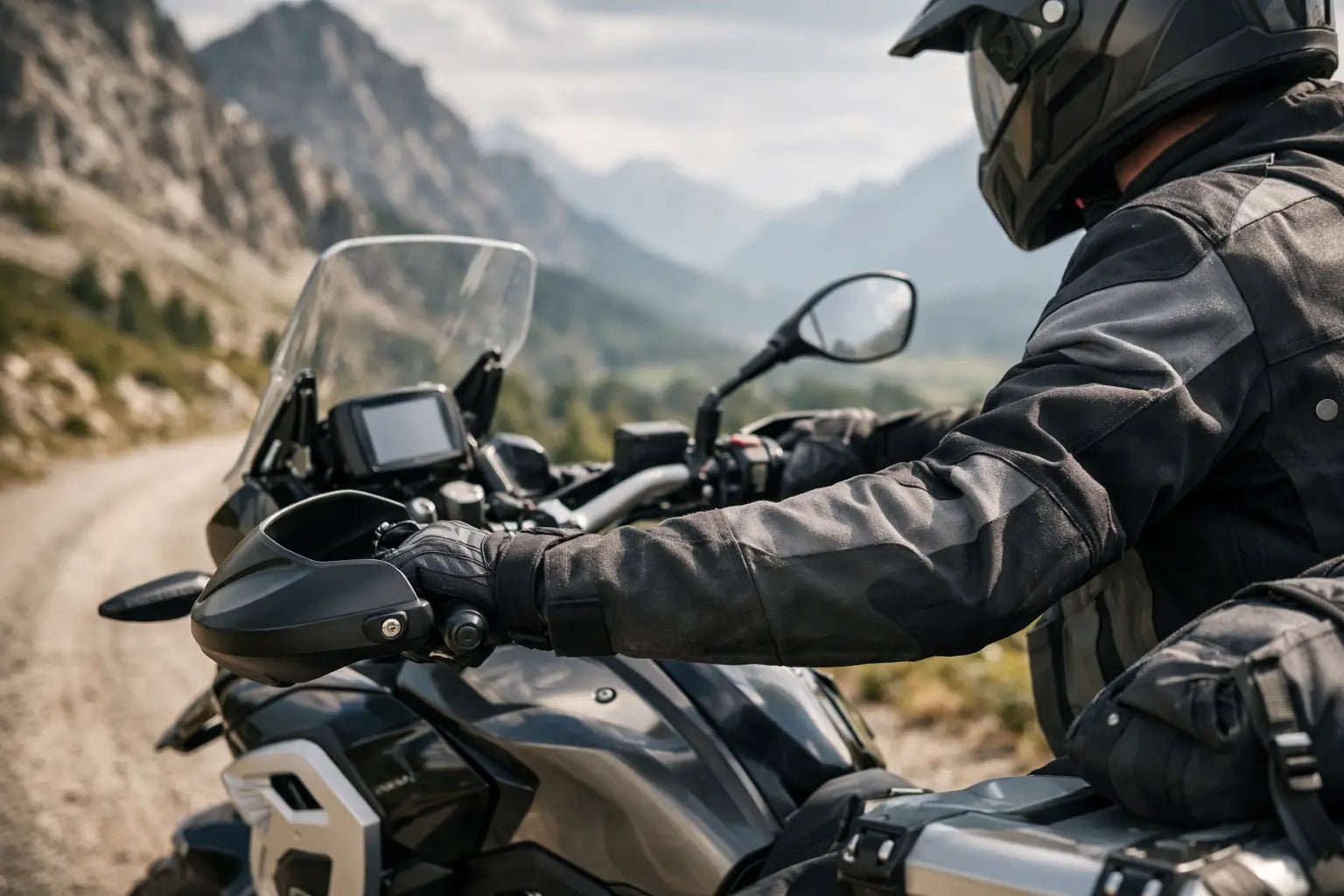
A broken brake lever after a harmless slide can bring a trip to a halt far more quickly than the wrong knobby tire. That is why universal adventure motorcycle handguards are not a secondary accessory: they are functional protection that affects safety, comfort, and riding continuity, especially when alternating between asphalt, dirt roads, and long stretches of travel.
When preparing a maxi-enduro or dual-sport for travel, riders tend to focus first on luggage, engine protection, and navigation. That makes sense. But handguards work every minute, even when you do not notice them. They protect your hands and controls from cold air, rain, stones, branches, and low-speed impacts. The real question is not whether you need them, but whether a universal solution is right for your motorcycle.
When universal adventure motorcycle handguards make sense
The universal version is designed to fit multiple handlebars and configurations. It is an attractive choice when you want to improve protection quickly without relying on a kit dedicated to a single model, or when you have already modified the cockpit, handlebar bend, risers, or controls and the original model-specific component is no longer the most straightforward solution.
On motorcycles such as BMW GS, KTM Adventure, Africa Twin, or Ténéré, however, universal does not mean automatic compatibility. Between radial brake pumps, fluid reservoirs, windscreen mounts, windscreens, TFT displays, and switchgear, the space around the handlebar is often more complex than it appears. A good universal handguard must therefore offer genuine adjustability, not just a bracket that “more or less fits.”
If you use the motorcycle mainly on the road for medium- to long-distance touring, a good universal handguard can deliver excellent results, especially as an aerodynamic barrier and weather shield. If, on the other hand, you ride light or moderate off-road routes with frequent impacts, stationary drops, or tight passages through the woods, the quality of the structure and mounting points becomes decisive.
The difference between cosmetic and protective handguards
Not all handguards do the same job. This is the point that often leads to the wrong purchase.
Open handguards
Open models, often made up of a single plastic cover, shield against wind, water, and small debris. They are useful for road touring and improve comfort in cold or rainy seasons. In return, they offer limited protection in the event of an impact or fall. If you hit a stiff branch or lay the motorcycle down, they are unlikely to save the lever and switchgear the way a reinforced structure would.
Closed handguards with an aluminum backbone
They are the most sensible choice for genuine adventure use. The internal aluminum bar connects the end of the handlebar to an inner mounting point and creates a structure capable of absorbing impacts, deflecting branches, and protecting the levers. They weigh more and require greater care during installation, but in return they offer real protection. On a motorcycle designed to go anywhere, this is the type of solution that makes the most sense.
What to check before buying
This is where everything is decided. A well-chosen universal handguard is useful. A poor choice becomes a source of vibrations, interference, and limited adjustment.
Handlebar diameter and mounting system
The first check concerns the handlebar. You need to know whether you have a variable-diameter handlebar with an oversized center section, a standard configuration, or any adapters already installed. The kit must be compatible with the inner clamping point and the bar ends. Some systems use internal expanders, while others require specific inserts or free space that not every motorcycle has.
On modern adventure motorcycles, especially those equipped with heated grips or unusual bar-end weights, the handlebar end should not be treated as a minor detail. Incorrect mounting can compromise handguard stability or create play over time.
Space around levers and reservoirs
The brake and clutch levers must move freely through their entire range. It sounds obvious, but many problems start here. A handguard that sits too close to the lever can restrict operation or make contact during hard braking. The same applies to brake-fluid reservoirs, which are often exposed and bulky, and to electrical switchgear with wiring positioned very close to the handlebar bend.
You therefore need a system that can be adjusted both in width and angle. The more technologically crowded the cockpit area, the more adjustment matters.
Windscreen height and steering angle
On some motorcycles, the problem is not static installation but dynamic clearance. With the handlebar straight, everything may seem perfect, but at full lock the handguard can touch the windscreen, navigation mounts, or fairing components. This is common on maxi-enduros with substantial aerodynamic protection.
Before considering the job complete, always check the full steering movement, both with the motorcycle unloaded and with any accessories installed in the front area.
Materials: plastic, aluminum, and build quality
In the adventure world, material is not marketing; it is function. The outer cover must withstand flexing, abrasion, and temperature changes without cracking at the first impact. When present, the inner bar must be rigid enough to provide protection without deforming immediately, but it must not transfer the entire impact brutally to the mounting points either.
Aluminum remains the most balanced solution in terms of weight, strength, and mounting precision. The quality of the hardware, bushings, and brackets also matters greatly. If a system tends to loosen with vibration and prolonged use, its theoretical protection loses value in the real world.
For those who travel long distances, maintenance matters too. A handguard with well-made components can be easily removed and realigned after a light impact, without turning a quick inspection into a workshop job.
Universal or model-specific?
There is no single answer that works for everyone. It depends on how you use the motorcycle, the bike itself, and how extensively the cockpit has been prepared.
Model-specific handguards have an advantage when you want more predictable installation, dimensions designed for the vehicle, and fewer potential conflicts with original components. They are often the cleanest choice on recent motorcycles with lots of electronics and limited space.
Universal handguards, on the other hand, make sense when you want flexibility, have already modified the riding position, or need a solution suited to customized configurations. They can work very well, but they require more technical care when choosing. In practice, they offer more freedom and fewer shortcuts.
For an experienced rider, this is not a limitation. It is simply a stricter purchasing criterion.
How to choose the right handguards for your riding
If you mainly ride on the road, focus on aerodynamic coverage, stability at high speeds, and freedom from vibrations. In this scenario, hand comfort, especially in cold and rain, is almost as important as mechanical protection.
If you alternate between asphalt and dirt roads, choose a closed structure with an aluminum backbone, a good range of adjustment, and replaceable covers. It is the best compromise for riders who genuinely travel and do not want to discover the product's limits at the first off-road tip-over.
If you use the motorcycle on more technical routes, prioritize the strength of the bar, the solidity of the mounts, and genuine compatibility with aftermarket levers, risers, or oversized handlebars. In this case, aesthetics come second. Protection and installation precision come first.
Riders looking for carefully selected accessories for real-world adventure motorcycle use gain a concrete advantage from a search guided by model and compatibility, as on endurrad.com. Not because universal products are automatically suitable, but because the right technical context helps avoid common mistakes.
Common mistakes to avoid
The most common mistake is evaluating only the handlebar diameter. It is necessary, but not enough. You need to consider the entire volume around the controls.
The second mistake is assuming that all closed handguards offer the same protection. There are significant differences in aluminum thickness, bar geometry, and mounting quality.
The third is overlooking how the motorcycle is actually used. A set designed to improve winter comfort may be excellent for touring but inadequate for riders who tackle fast dirt roads or forest trails.
Finally, there is rushed installation. Alignment, tightening torque, and checking the steering lock are not minor details. They are part of the product's functionality.
Universal adventure motorcycle handguards: the right choice only when chosen well
Universal adventure motorcycle handguards are not a fallback solution. They can be a valid technical choice, even on high-end motorcycles, provided you carefully assess compatibility, construction, and intended use. What many see as a simple accessory is actually a component that must work alongside ergonomics, control protection, and cockpit geometry.
If your goal is to prepare the motorcycle for long trips, changing weather, and sections away from paved roads, it is worth choosing with the same criteria you would use for an engine guard or a luggage system. Because adventure begins with the details that keep working when the road stops being easy.



Share:
Adventure motorcycle radiator guards: how to choose them
Off-road Motorcycle Armor Guide