

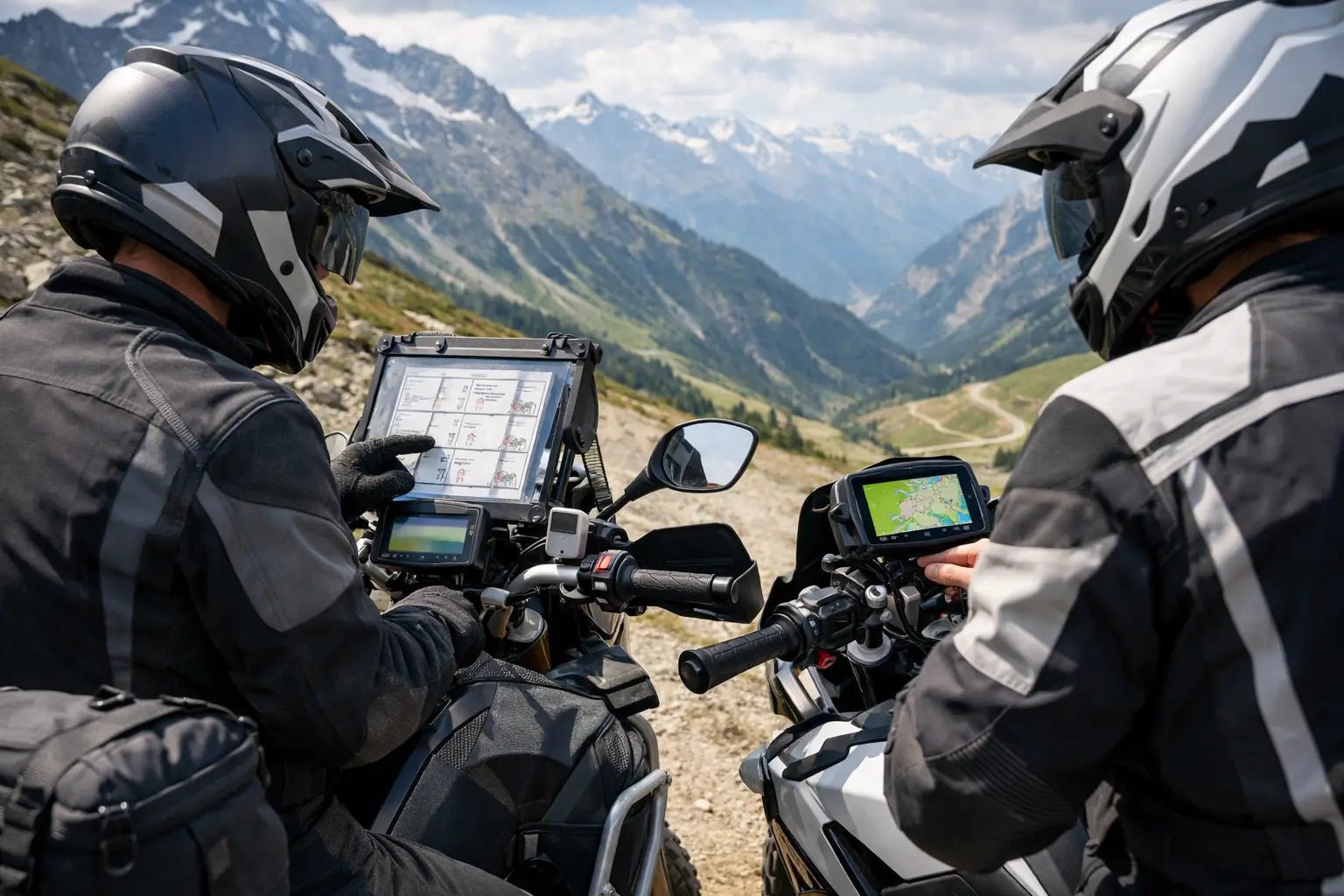
When the terrain breaks up, the track disappears from the display, or the route doesn't follow a real road, the difference between a digital roadbook vs. GPS stops being theoretical. It becomes a matter of riding, attention, and margin of error. For those who travel in adventure or tackle dirt roads, choosing the right system means having more control over navigation and less improvisation when the terrain truly changes.
Digital Roadbook vs. GPS: The Real Difference
The most useful distinction is not technological, but functional. GPS primarily works with maps, tracks, and position. It tells you where you are and, depending on the device and loaded file, shows you where to go. A digital roadbook, on the other hand, operates on progressive advancement: total distance, partials, directional notes, dangerous points, references, and the sequence of the route.
In practice, GPS is excellent when you want to orient yourself in space. The roadbook is more effective when you need to faithfully follow an itinerary defined by its creator. These are two different logics, and anyone who rides a motorcycle on asphalt, gravel roads, and light to medium off-road will understand this after just a few hours of use.
On a BMW GS, an Africa Twin, or a KTM Adventure, GPS tends to integrate better with mixed and touring use. The digital roadbook, however, comes into play when the route has a more technical structure, such as adventuring events, amateur rallies, tracks with hidden waypoints, or itineraries where the map alone is not enough.
How GPS Works in Adventure Motorcycling
GPS is the most immediate tool for most motorcyclists. You load a GPX track, follow the line, check the map, and manage detours or alternatives in real-time. For long-distance travel, it's hard to beat, especially if you combine a readable screen, a solid mount, and stable power.
The main advantage is the overall view. If you are traversing an unknown area, the GPS shows you the context: secondary roads, waypoints, elevation changes, alternatives, and any route errors. This makes it very effective in touring and classic adventure, where the goal is not to follow a note to the letter but to arrive safely, without wasting time or stress.
However, there is a clear limitation. GPS can encourage riding while looking at the map instead of the terrain. Off-road, especially on fast tracks or bumpy surfaces, reading a thin line on the display is not always the most intuitive way to stay focused. Furthermore, if the track was poorly recorded, if the file is corrupted, or if the cartography does not reflect the actual passage, the margin of interpretation increases.
What Changes with a Digital Roadbook
The digital roadbook brings the logic of rallies to motorcycling, but in a more accessible and practical form than paper rolls. On the display, you don't follow a complete map; you follow sequential instructions. Each note corresponds to an action, a distance, a reference, or a danger. This significantly changes the way you ride.
Attention shifts from "where I am on the map" to "this is the next useful piece of information." On variable terrain, poorly legible junctions, or sections without obvious references, this setup can be clearer. You don't have to interpret a track on the screen amidst other roads or trails. You simply need to confirm that the mileage and reference match.
The advantage is operational precision. The disadvantage is that it requires more method. A digital roadbook works well if the route is well prepared, if the rider knows how to zero or correct the trip, if the system is mounted rationally, and if the rider is willing to learn a different logic from a classic navigator.
Digital Roadbook vs. GPS in Real-World Use
For Road Trips and Long-Distance Touring
Here, GPS remains the most natural choice. It helps you manage stages, variations, refueling, and travel times. If it rains, if you change plans, if you need to avoid a section or look for an alternative, the map remains the most flexible tool.
The digital roadbook in this context is less practical. It might only make sense for organized itineraries with a precise structure, but for free travel, it adds complexity where simplicity is often needed.
For Asphalt and Gravel Adventure
This is the terrain where the two systems truly begin to overlap. If you ride gravel roads, alpine passes, mixed connections, and non-extreme off-road sections, GPS remains very valid. It allows you to read the terrain and manage unforeseen events without interrupting your rhythm.
The digital roadbook becomes interesting if you participate in roadbook-guided events or if you want a more technical navigation experience, closer to enduro raid. It's not automatically better, but it changes the type of involvement. It demands more concentration on the route and less reliance on a cartographic view.
For Off-Road with Technical Navigation
Here, the digital roadbook often has a concrete advantage. When the route does not coincide with a clear road, when there are multiple intersections, subtle deviations, or specific points of attention, the progressive note system can be more legible and disciplined than simply following a track.
GPS continues to be useful as a safety and general orientation aid, but it is not always the best tool for following an itinerary built with rally logic. For this reason, many experienced motorcyclists don't choose one system over the other. They use them together, each for what it does best.
Ergonomics, Mounts, and Readability: More Important Than It Seems
In the digital roadbook vs. GPS comparison, the device alone is not enough. The position of the mount, reading angle, vibrations, power supply, and interaction with gloves all matter. An excellent navigator poorly mounted becomes frustrating. A digital roadbook installed too low forces you to lower your gaze more than necessary.
On motorcycles like the Yamaha Ténéré 700, KTM 890 Adventure, or Honda Africa Twin, the cockpit area must be designed carefully. If you ride standing for long stretches, the display must remain clear even in motion. A stable, well-secured structure is needed, designed to withstand dirt, bumps, and continuous vibrations. This is where the quality of mounts and navigation components makes a real, not just aesthetic, difference.
The interface also matters. GPS is often more intuitive at first. The digital roadbook requires more getting used to, especially in trip management and quick interpretation of notes. But once assimilated, it can become very efficient.
When to Choose GPS
GPS is the right choice if your primary use is touring, mixed travel, and free navigation. It works well if you want to load tracks, see the geographical context, and have a versatile tool for every outing. It is particularly suitable for those who cover many kilometers, alternate between asphalt and easy dirt roads, and prefer an immediate interface.
It is also advisable for those who prepare their motorcycle for long journeys, where decision-making autonomy and the ability to adapt to the route matter more than the millimeter-perfect precision of one note after another.
When to Choose a Digital Roadbook
A digital roadbook makes sense if you are looking for more technical navigation, participate in dedicated events, or want to follow routes designed with rally logic. It is a consistent choice for those who appreciate progressive orientation, work well with partial distances, and want a system focused on route execution.
It is not a solution for everyone, and that is the point. It does not automatically replace GPS. It only surpasses it in certain scenarios, where the track structure and type of riding reward a more methodical approach.
The Best Choice Is Often Not Either/Or
For many experienced adventure motorcyclists, the most sensible solution is to combine the two tools. GPS for the general overview, transfers, variations, and safety. Digital roadbook for precisely following a technical route when truly needed. This is not redundancy; it is specialization.
This approach requires a well-equipped motorcycle, with reliable mounts, protected power supply, and components designed for intensive use. But when the cockpit is configured correctly, navigation becomes more readable, safer, and closer to your riding style.
If you are deciding what to install on your motorcycle, the right question is not which system is absolutely better. It is which system helps you ride better in the type of adventure you actually do. From there, a sensible choice begins, and often the pleasure of the journey changes considerably as well.









Share:
Approved auxiliary spotlights guide
How to choose heated motorcycle grips