

The battery is the most expensive component of an electric scooter and the only one that truly wears out. It's also the subject of the most misinformation, almost all of it inherited from outdated technologies: the memory effect, the obligation to fully discharge before recharging, and the idea that partial recharges "ruin" the battery pack.
None of these things apply to lithium. Here's how it really works, how long it lasts, what damages it, and the concrete habits that make the difference between replacing it in its fifth year or its tenth.
In brief
- Stated lifespan: 600-800 full cycles before dropping to 80% capacity.
- Partial recharges do no harm: lithium performs best between 20% and 80%.
- The two real enemies are heat and prolonged storage at zero or 100% charge.
- A household socket is sufficient: power draw is around 300 W, like a refrigerator.
How an electric moped battery is made
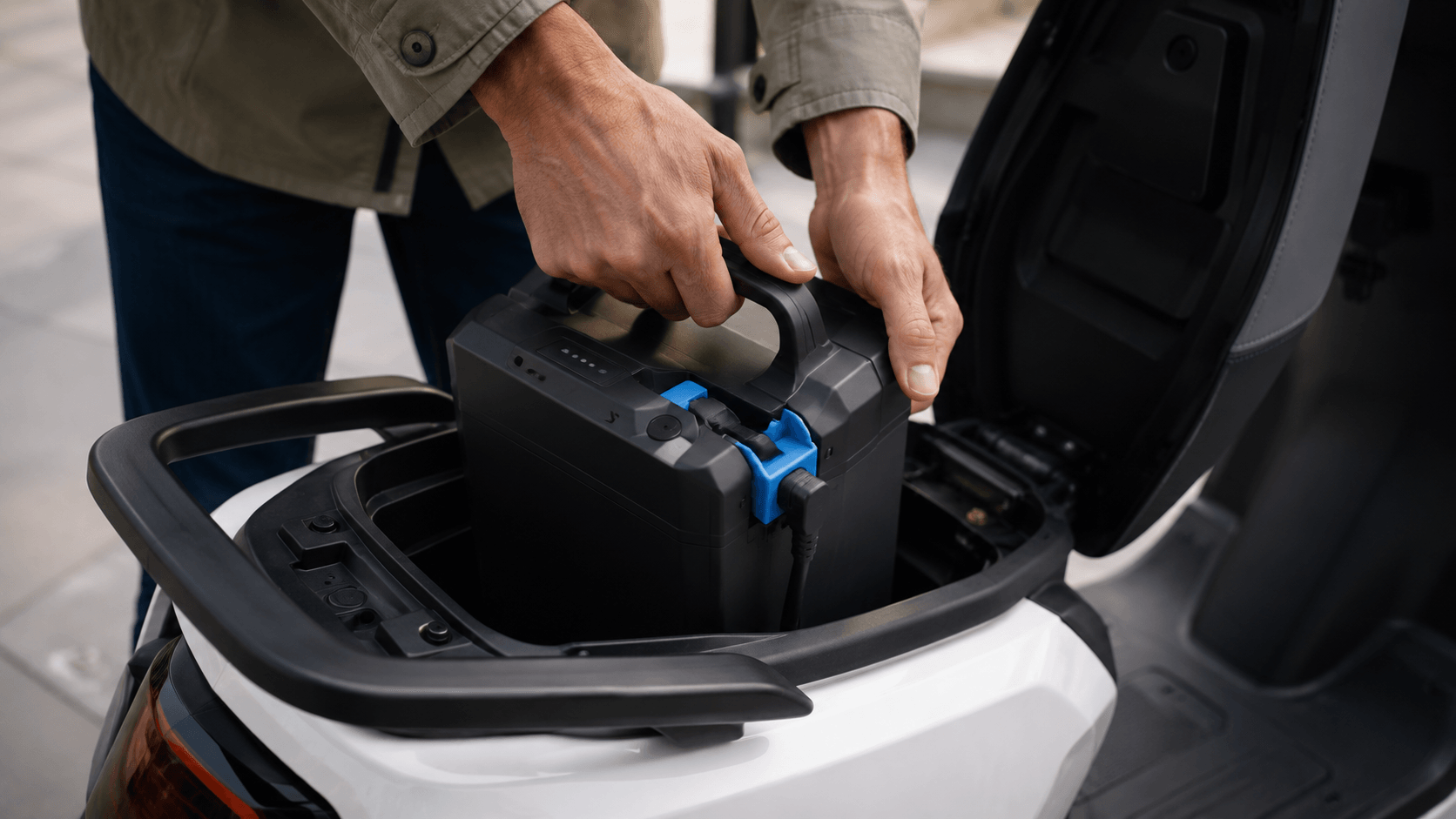
On an L1e (45 km/h) vehicle, the typical battery pack is 60 volts with a capacity of around 26 Ah, which means approximately 1.5 kWh of stored energy. It weighs between 13 and 14 kg and in recent models, it is removable: it slides out of the compartment under the seat and can be taken to where there is an outlet.
It doesn't just contain cells. There's also a BMS, the electronic system that manages the pack: it balances the cells, stops charging when full, cuts off power if the voltage drops too low, and protects against overcurrents and abnormal temperatures. This is why a modern battery is difficult to accidentally ruin, and also why you should use the original charger, which communicates with that system.
The most common chemistries in this range are traditional lithium-ion and lithium iron phosphate (LiFePO4). The latter generally offers more life cycles and greater thermal stability, at a slightly higher weight for the same energy. It's worth checking which one the model you're considering uses: this information should be in the technical specifications.
How long it really lasts
Manufacturers state 600-800 full charge cycles. This number needs to be interpreted correctly, as it's the source of almost all misunderstandings.
A cycle is not a charge
A full cycle corresponds to a complete discharge and recharge of the entire capacity, not just plugging it in. If you recharge from 60% to 100%, you've used four-tenths of a cycle, not one. Those who make short trips and recharge every evening consume far fewer cycles than they count.
The end of cycles is not the end of the battery
After 600-800 cycles, the battery doesn't stop working: it has lost about 20% of its original capacity. A pack that used to give 55 km now gives 44 km. The vehicle continues to function identically, simply with less range, and continues to degrade slowly from that point onward.
Time matters as much as use
Lithium batteries also age when not in use. This is known as calendar aging, and it primarily depends on two factors: the temperature at which the pack is stored and the state of charge at which it is left. A pack kept at 100% in a hot garage always ages much faster than the same pack kept at half charge in a cool place, for the same mileage.
Translated into years
With a real range of 40-55 km and urban mileage of 5,000 km per year, approximately 100-125 full cycles are needed annually. This means five to seven years before approaching the 80% threshold, and several more years of useful life after exceeding it. Those who travel 10,000 km per year halve these times.
How to charge it
Nothing special is needed, and this is the point that surprises those coming from the world of electric cars the most. A 1.5 kWh pack that recharges in 4-6 hours draws about 300 watts: less than a hairdryer, similar to a refrigerator. A normal household socket is sufficient, without a wallbox, without increasing the meter's power, and without condominium authorizations.
| Item | Typical value |
|---|---|
| Full charge time | 4-6 hours |
| Power consumption | approx. 300 W |
| Cost of a full charge | €0.41 - €0.49 |
| Socket required | Standard household |
| Weight of removable pack | 13 - 14 kg |
Reference domestic electricity tariff: €0.30/kWh. Times refer to charging from nearly empty to full with the supplied charger.
Seven habits that extend battery pack life
1. Stay between 20% and 80%
This is the range where the cells operate with the least stress. Recharging to 100% every time is not necessary if your daily commute only requires half the range, and it accelerates degradation.
2. Charge often, not completely
The memory effect does not exist for lithium: it was a problem with nickel-cadmium batteries from the nineties. Frequent partial charges are the best way to use it, not a compromise.
3. Don't leave it discharged
This is the single most damaging mistake. A pack left at zero for weeks can fall below the minimum safety threshold, causing permanent damage to the cells or locking the BMS. If the vehicle is stationary, check the charge every two months.
4. Let it rest before plugging it in
After a long journey, the pack is hot. Recharging a hot battery increases thermal stress. Twenty minutes of waiting is enough.
5. Use the original charger
This is not a commercial clause. The supplied charger has voltage, current, and a charging profile calibrated for that pack's BMS. Generic chargers are the most frequent cause of failures not covered by warranty.
6. A full charge every now and then is useful
This seems to contradict the first point, but it doesn't: bringing the pack to 100% once a month allows the BMS to rebalance the cells and recalibrate the residual charge estimate. It's maintenance, not daily use.
7. Bring it inside
The advantage of a removable battery is not only being able to charge it at home: it's also protecting it from temperature fluctuations. A battery pack that spends the summer in a garage at 45 degrees Celsius ages much faster than one kept indoors.
Cold and heat: what really happens
Cold reduces range but does not damage. Below 5 °C, internal chemical reactions slow down and available capacity decreases, typically between 15% and 25%. This is a temporary loss: when it gets warm again, the range returns to its previous level. The only important precaution is not to recharge a pack below freezing, because under those conditions, charging can cause permanent damage to the cells. If the battery is removable, this is not an issue: you bring it indoors and charge it at room temperature.
Heat causes permanent damage. It's the opposite: high temperatures do not reduce range at the moment, but they accelerate degradation irreversibly. A pack left in the sun under the seat in summer is the worst condition, and in Italy, it is also the most common. If you can choose a shaded spot, choose that one.
Winter storage
If the vehicle remains unused for months, how you leave the battery determines its condition when you retrieve it.
- Charge it to approximately 50-60% capacity, not 100% and especially not zero.
- Disconnect it from the vehicle and store it in a cool, dry environment, between 10 and 20 degrees Celsius.
- Check the level every two months and recharge to 50-60% if it has dropped.
- Do not leave it connected to the charger all winter.
When to replace it, and how to dispose of it
There are three signs that indicate a battery pack is at the end of its useful life: a clear and steady drop in range compared to previous months, noticeably longer charging times under the same conditions, and anomalous behavior of the charge indicator, which drops erratically or shows inconsistent levels. The latter often indicates unbalanced cells rather than an exhausted pack, and sometimes it can be resolved with a complete rebalancing charge.
Before ordering a replacement, ask the seller about the availability and price of the battery pack for your specific model. This is information you should have before purchasing the vehicle, not five years later.
Regarding disposal, the rule is clear: lithium batteries are special waste and should not be placed in unsorted waste or street bins. They should be handed over to the seller when purchasing a replacement, or taken to an authorized collection center. Besides being an obligation, this is the way to enable the recovery of materials contained in the cells.
Models with removable battery
All electric mopeds in our selection feature removable lithium battery packs, rechargeable from a household socket. If you have any questions about range, battery weight, or spare parts availability, please ask us before ordering.
See homologated electric scooters →
Free shipping in Italy over €100 · Free returns within 14 days
To understand how much the battery truly impacts the overall cost of the vehicle, read the comparison of electric vs. gasoline running costs, with the full five-year calculation.
Last updated: July 2026. Durability, capacity, and charging time values are indicative and refer to L1e category lithium packs under standard usage conditions. Always refer to your model's manual for exact specifications and warranty conditions.











Share:
Electric scooter: mandatory license plate, registration, and insurance
Electric scooter: what license do you need? Complete guide to L1e and L3e